How one jumper’s narrow escape might make you safer, too
Photos by Jarrad Nolan
In September 2025, Adrian Ferguson briefly became the most famous skydiver in the world – though not for the reasons anyone would want. A video showing him dangling from the tail of an aircraft by his reserve parachute went viral, appearing on news programmes and in newspapers across multiple continents. What the footage captured was a terrifying scenario that most of us consider purely theoretical. Unfortunately, it absolutely isn’t.
What the stories don’t fully reveal was the remarkable combination of preparation, training, and clear thinking that allowed Ferguson to survive the experience. If such a day should come for you, dear reader, this author’s fond hope is that you find the same reserves within.
A routine exit gone wrong
Ferguson, a 51-year-old Australian with over 2,000 jumps and 21 years in the sport, was participating in “Big Ways on the Beach,” a multi-day event designed to upskill skydivers in formation flying. Held near Tully in Queensland, the event had been partially weather-affected, making this the third actual jumping day, despite being day five of the camp.
It was the first jump of the morning, just before 10am. Ferguson had volunteered for the front float, which he genuinely enjoys. He estimates he’s been there somewhere between two and three hundred times across his skydiving career, predominantly from short Caravans like the one they were using that day.
As he swung out of the aircraft door and stood up, something felt slightly different. The air seemed fractionally easier than usual, perhaps due to minor variations in prop wash or wind direction. Ferguson believes he positioned himself about an inch further forward than intended. As tiny as it was, the difference proved catastrophic.
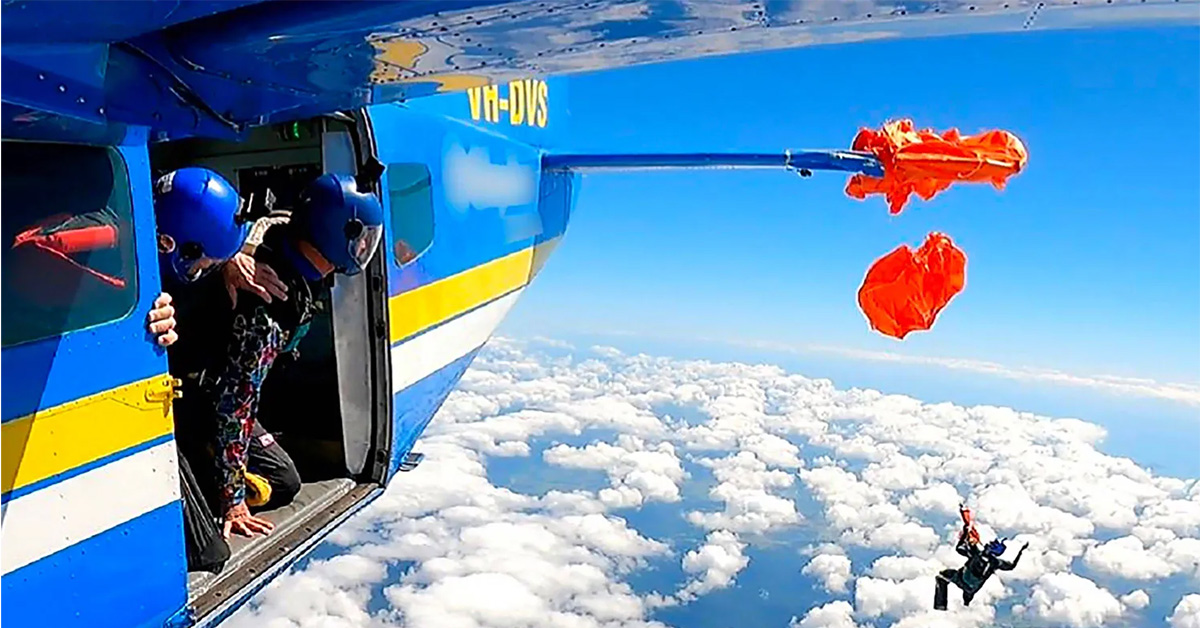
The trailing edge of the aircraft’s flap, at 15,000ft, deployed to its 10-degree position for the jump run, made contact with the top of his reserve deployment handle. As Ferguson finished straightening up, the handle rolled off its Velcro retainer. The cable stretched until it cleared the closing loop, and his reserve pilot chute deployed.
Fifty seconds of crisis
What followed was approximately 50 seconds of barely controlled chaos. Ferguson felt a tap on his back. He initially mistook it for another jumper (as anyone in that situation would). That tap was followed by another impact as the reserve canopy began extracting from his container. Within moments, he was ripped backwards off the aircraft, tumbling and striking every surface along the way with various parts of his body.
His hands instinctively went to protect his head, then he almost unconsciously reached for the risers. When he finally caught up with what had happened and looked up, he caught sight of orange fabric wrapped around the horizontal stabiliser. “F***, that’s my reserve,” he thought, immediately understanding the gravity of the situation.
Ferguson’s response was remarkably systematic. After a half-second thought for the plane full of skydivers behind him (whom he hoped were evacuating the plane) he went for his hook knife.
The lanyard that saved his life
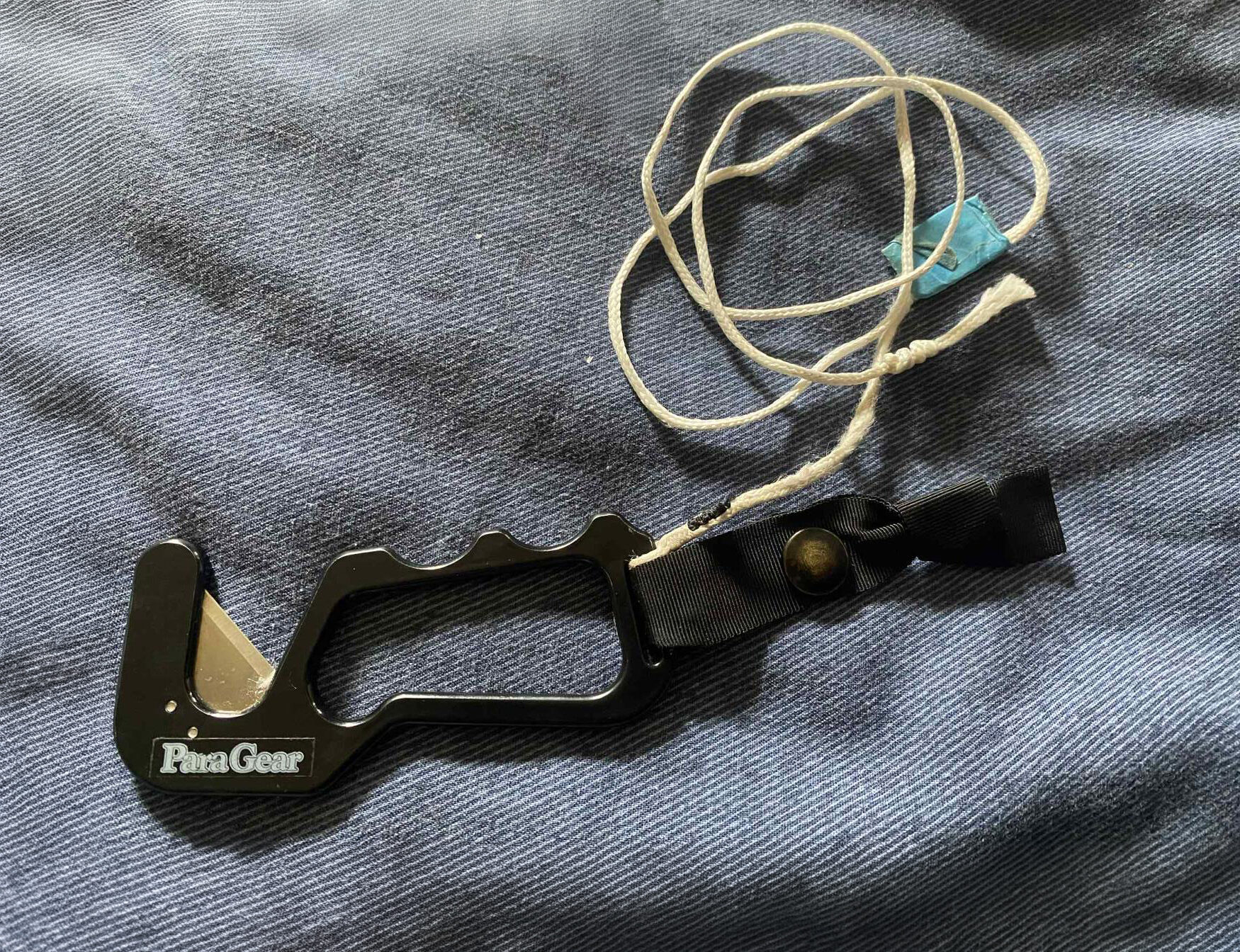
Ferguson’s hook knife wasn’t standard equipment. His rigger, an experienced former CREW dog, had suggested a modification: a three-foot lanyard of closing loop cord, finger-trapped and bar-tacked into the knife handle, with the other end attached via elastic to the inside of the knife pouch. The reasoning checks out: in a high-stress emergency, you will drop things. With that lanyard, in a (rare, but non-zero-occurrence) situation like this one, dropping the knife becomes a momentary inconvenience rather than a death sentence.
The modification proved essential. Fighting against violent buffeting while hanging from the aircraft’s tail, Ferguson began cutting whatever lines he could reach. The knife dulled quickly – he noticed significant degradation after just two or three cuts – but he persisted, eventually severing approximately 11 suspension lines. Combined with two that broke on initial impact, 13 of his reserve’s lines were compromised before he finally separated from the aircraft.
Managing the unmanageable
The challenge didn’t end with his separation. Ferguson’s main parachute deployment was complicated by the trailing remains of his partially deployed reserve. As he pulled his PC, the imbalance of forces rolled him onto his back. He found himself looking at his pilot chute resting on his chest.
The main canopy deployed into the trailing reserve lines, creating immediate spinning line twists. Ferguson knew instinctively that cutting away wasn’t an option – his reserve was already compromised and streaming uselessly behind him. For the first time during the entire incident, he felt genuinely scared.
Then something clicked. “Think,” he told himself. Recognising he was spinning right, he reached up past the twists and grabbed what turned out to be his left steering line. He pulled too far initially, reversing the spin direction, then modulated his input to stop the rotation entirely. Once level, he kicked himself out of the line twists and found himself under a three-quarter inflated main canopy with his damaged reserve streaming behind like an oversized drogue.
Landing and aftermath
Despite everything, Ferguson executed a reasonably controlled landing pattern. He started higher than usual, to account for the additional drag from the trailing reserve. He conducted practice flares during his descent (and recognised that the reserve’s influence would complicate his touchdown). He attempted a PLF but admits forgetting to turn his feet to the side – a detail that someone who has taught the technique found ironically amusing.
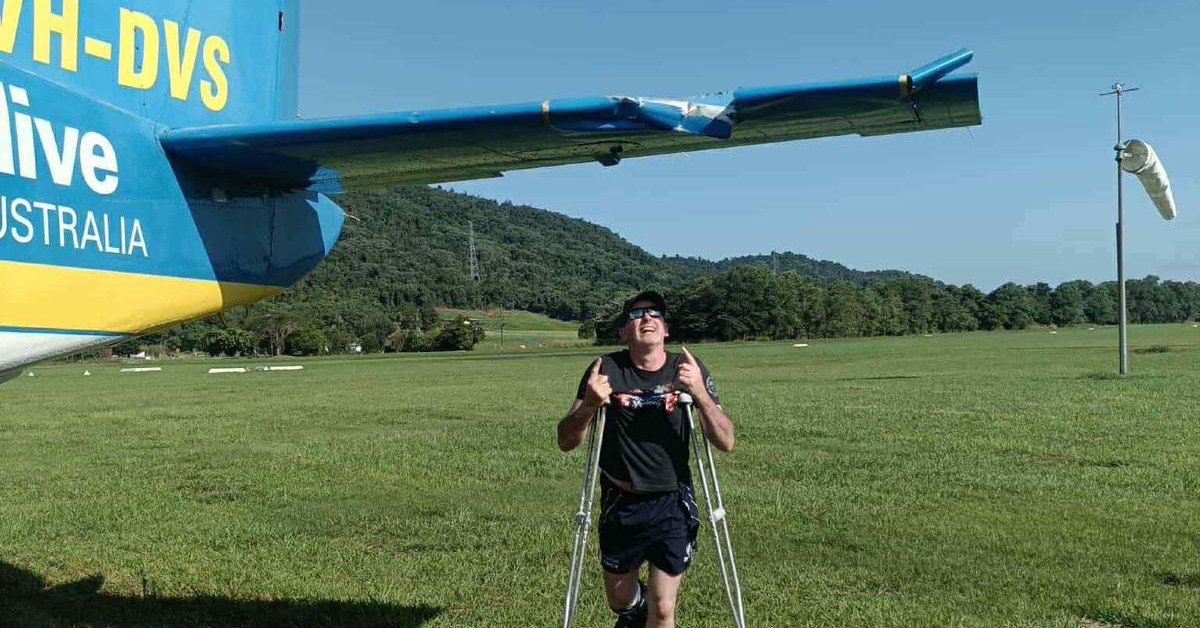
Ferguson’s injuries included an 11-centimetre gash to his shin that required 15 stitches, reaching all the way to the bone. Remarkably, this was the extent of his serious physical harm. He was back at work within four weeks. He returned to skydiving eight weeks after the incident.
Lessons for the skydiving community
Ferguson’s survival wasn’t luck, though luck certainly played a role. His preparedness came from years of absorbing stories and lessons from experienced CREW skydivers, who made a practice of presenting scenarios and asking, “What would you do here?”
The value of preparation
Perhaps the most striking aspect of Ferguson’s account is how much thought he had invested in scenarios he never expected to face. The lanyard on his hook knife. The practice time extracting the knife from its pouch, including with his non-dominant hand. The understanding of his equipment’s behaviour that allowed split-second recognition of his situation.
“You’re usually only lucky if you act,” Ferguson observes. “Do something.” But the corollary is equally important: the right action in a crisis emerges from preparation conducted long before the crisis occurs. Ferguson’s 50 seconds of controlled response were built on 21 years of thoughtful engagement with his sport.
Ferguson’s recommendations
- Know your gear intimately. Ferguson’s instant recognition of his situation upon seeing orange fabric on the stabiliser potentially saved his life. Had he instinctively executed a cutaway, he would almost certainly have died.
- Think before acting. The head of the Australian Parachute Federation described Ferguson’s response as “an excellent example of dealing with one problem at a time until no problems remained.” Ferguson attributes some of this ability to his background umpiring Australian Rules football – a role that requires observing, processing, and making decisions under physical and mental stress.
- Consider adapting your hook knife with a lanyard. The modification cost virtually nothing but provided the margin that made everything else possible. As Ferguson notes, skydivers willingly spend significant money on automatic activation devices they hope never to use. A properly secured hook knife costs a fraction of that amount and proved, in his case, to be equally essential.
- Don’t forget to ask “why”– even in crisis situations. Under his main canopy, Ferguson caught himself reaching for his knife again with some vague intention to cut more lines. He stopped himself by asking why, and realised there was no good reason. The instinct to “do something” must be tempered by the discipline to only do useful things.
Three months after the incident, Ferguson still hadn’t seen his own footage. He was there, he notes, but he doesn’t need to relive it. But he’s more than willing to discuss what happened, both to process his own experience and to help others prepare for emergencies they hope will remain purely theoretical.
In the skydiving community, the best stories are often the ones you never want to earn. Adrian Ferguson earned his in the most dramatic way possible, and his willingness to share every detail may well save someone else’s life someday.
Hear the full story on Radio Skydive UK (radioskydive.uk), Europe’s #1 skydiving podcast, hosted by Craig Poxon and Brian Cumming. Listen to over 100 episodes, wherever you get your audio.